Issued: May 14, 2026
- An updated IPC analysis confirms that acute food insecurity and acute malnutrition in Somalia remain extremely concerning and continue to deteriorate, with a risk of Famine in one location. The update takes into consideration the impacts of volatile weather patterns, price increases due to the 2026 conflict in the Middle East, and flood risks on conditions previously projected for April to June 2026. By providing a real-time assessment, the analysis results underscore the urgent need to increase and sustain multisectoral humanitarian assistance to prevent further deterioration and loss of life and livelihoods.
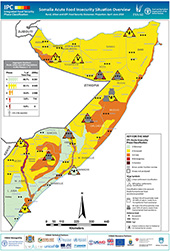
- Results of the multi-partner countrywide food security assessments conducted in November and December 2025, and subsequent IPC Acute Food Insecurity analysis indicated a worsening food insecurity situation in Somalia. Approximately 4.8 million people experienced high levels of acute food insecurity (IPC Phase 3 or above) in January 2026. This included about 1.2 million people (6 percent of the population) in IPC Phase 4 (Emergency), and more than 3.6 million people (19 percent of the population) in IPC Phase 3 (Crisis). An additional 7.4 million people were classified in IPC Phase 2 (Stressed).
- Between April and June 2026, an estimated 6 million people (31 percent of the analysed population) across Somalia are facing high levels of acute food insecurity, representing an increase of about 509,000 people in IPC Acute Food Insecurity (AFI) Phase 3 or above compared to the previous projection. The updated estimate includes close to 1.9 million people (10 percent of the population analysed) in IPC Phase 4 (Emergency).
- The deterioration is driven by interlinked factors: the poor performance of the ongoing April-to-June 2026 Gu season rainfall, escalating food prices exacerbated by the 2026 conflict in the Middle East, the rejection of Somali Shillings by traders and service providers that led to a decline in its value in southern regions, conflict and insecurity causing livelihood disruptions and displacement, and heightened flood risks in riverine areas , exacerbated by limited humanitarian assistance which is only covering a small fraction of the needs in many areas. Crucially, this worse-than-expected food insecurity situation follows a trend of concerning deterioration, as the number of people in IPC AFI Phase 3 or above in the first projection period—February to March 2026—already reflected a near doubling in severity compared to the first quarter of 2025.
- The nutrition situation has also worsened in most parts of Somalia compared to the January 2026 analysis. The updated analysis finds approximately 42,000 more children are expected to need treatment for acute malnutrition in 2026 than previously expected, rising to a total of nearly 1.88 million children. This increase is driven by the worsening acute food insecurity, increased disease burden, sub-optimal child feeding practices, inadequate health, nutrition and water and sanitation services. It is exacerbated by severe funding constraints.
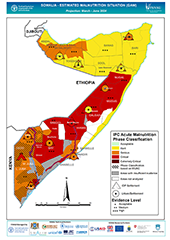
- Of the 35 hotspot areas analysed, 23 will likely deteriorate or remain stable within IPC Acute Malnutrition (AMN) Phase 4 (Critical), while nine will deteriorate or remain stable within IPC AMN Phase 3 (Serious). Two areas are projected to deteriorate from IPC AMN Phase 3 to IPC AMN Phase 4, including internally displaced persons (IDPs) in Baardhere and communities in rural areas of Xarardhere and Ceeldher districts. However, Belet-Hawa Urban will likely improve from IPC AMN Phase 4 (Critical) to IPC AMN Phase 3 (Serious).
- The deterioration is particularly alarming in Bay Agropastoral Livelihood Zone, which is in IPC AMN Phase 4 (Critical) with a global acute malnutrition (GAM) rate of 25.2 percent. Within this region, Burhakaba district is classified in IPC AMN Phase 5 (Extremely Critical) with an alarming 37.1 percent GAM rate. When an area is in IPC AMN Phase 5, at least one out of three children are expected to be acutely malnourished, with many more children expected to die from preventable diseases due to complications.
- Even more worryingly, the IPC analysis found Burhakaba District to be at risk of Famine under a plausible worst-case scenario of failing Gu rains, soaring food prices and below expected delivery of humanitarian food security assistance (HSFA). As such, scale up of multisectoral food security, nutrition, health and WASH interventions is urgently needed to avert extreme food gaps and rising mortality, particularly for young children.
- Humanitarian assistance remains the critical lifeline for saving lives and livelihoods and addressing acute food insecurity and malnutrition in Somalia. Compared to the previous projection, Humanitarian Food Security Assistance (HFSA) for April to June 2026 has increased significantly and now reaches nearly 700,000 people per month. Despite these efforts, the planned assistance falls far short of meeting urgent needs. It covers only 12 percent of 6 million people in IPC phase 3 or above, and only 37 percent of those in IPC Phase 4.
- Life-saving humanitarian assistance needs to be scaled up and sustained urgently with a particular focus on hotspot areas, including Burhakaba District of Bay Region.
Click this link to download full report in pdf format.

 Send by email