Issued: November 25, 2026
- This report updates the October-December 2026 IPC Acute Food Insecurity (AFI) and Acute Malnutrition (AMN) projections for Baidoa IDPs presented in the Somalia IPC analysis conducted in August 2026 and published in September 2026, including the statement of risk of Famine. The update draws on new food security, nutrition, mortality, displacement, and seasonal monitoring data collected since the completion of the analysis, including a combined food security, nutrition, and mortality assessment conducted among Baidoa IDPs by the Food Security and Nutrition Analysis Unit (FSNAU/FAO) in late October 2026.
- For the rest of the country, IPC AFI and AMN projections for October-December 2026 remain unchanged compared to the August analysis. This report combines and presents the updated projection analysis for Baidoa IDPs and the previous projection for the rest of Somalia.
- The analysis conducted in August 2026 indicated that, under the most likely scenario, IDPs in Baidoa (Bay Region) faced AFI Phase 4 and AMN Phase 4 outcomes between the October–December 2026 projection period. The report also indicated a risk of Famine for this population group in the same period under the plausible worst-case scenario of El Niño-induced extreme flooding and displacement.
- Based on the available evidence, this projection update confirms that Baidoa IDPs face AFI Phase 4 and AMN Phase 4 outcomes between October and December 2026. However, this population group no longer faces a risk of Famine, considering that the plausible worst-case scenario has not materialised to date, and will likely not materialise through December 2026.
- Compared with the August 2026 projection, the updated findings for Baidoa IDPs indicate modest improvements in some key outcomes, while highlighting continued severe vulnerability. In the August analysis, 80 percent of Baidoa IDPs were projected to face AFI Phase 3 or above outcomes between October and December 2026, including 5 percent projected to face AFI Phase 5 (Catastrophe).
- In the most likely scenario, the November 2026 analysis indicates that 65 percent of Baidoa IDPs are projected to face AFI Phase 3 or above outcomes and no population is projected to face AFI Phase 5 (Catastrophe). Overall, the updated analysis estimates that 77,000 fewer Baidoa IDPs (19 percent fewer) will face AFI Phase 3 or above outcomes than projected in August. This reduction is primarily driven by less severe-than-anticipated El Niño-related flooding, improved access to agricultural employment and income, and stronger purchasing power due to declining, although still above-average, food prices.
- New displacements into Baidoa have been substantially lower than anticipated in the August 2026 analysis. Although insecurity in Baidoa generated an estimated 5,600 new displacements following the September 2026 conflict, this increase was more than offset by flood-related displacement remaining far below initial projections, with approximately 42,000 people projected to be displaced compared with the 89,000 anticipated in August. As a result, the overall number of new IDPs has been significantly lower than projected in the August analysis.
- Overall, severe conditions anticipated in the August 2026 projection will likely persist through the end of this year, although the worst-case scenario is not expected to materialise. The absence of severe flooding and improved access to agricultural labour opportunities in October have contributed to preventing worsening food security and nutrition outcomes. Nevertheless, the lingering effects of previous droughts in pastoral areas, flooding, continued insecurity, large-scale population displacement, and above-average food prices remain significant constraints on household food access and livelihoods, further exacerbated by limited humanitarian assistance. Consequently, households remain highly vulnerable through December 2026 and require sustained humanitarian support, alongside close monitoring of food security and nutrition conditions.
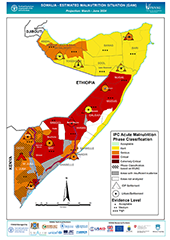
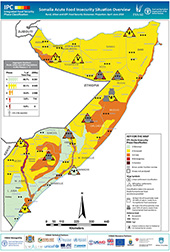
- As a result of the revised Baidoa IDP projections, the national October-December 2026 estimate has been slightly revised downward. Across Somalia, an estimated 5.3 million people (27 percent of the analysed population) are projected to face high levels of acute food insecurity (AFI Phase 3 or above) between October and December 2026, a slight improvement from the 5.4 million projected in August 2026. This includes nearly 1.5 million people (7 percent of the population analysed) in AFI Phase 4, with no population projected to face AFI Phase 5 (Catastrophe).
- Despite some improvements in food security outcomes, acute malnutrition among Baidoa IDPs remains a major concern. Compared with the August 2026 analysis, the updated IPC AMN analysis estimates an additional 7,000 cases of children who will require treatment for acute malnutrition between July 2026 and June 2027. As a result, the total number of children in need of treatment (acute malnutrition burden) across Somalia has been slightly revised upward to 1.92 million (0.4 percent increase) which includes 437,000 cases of severe acute malnutrition (SAM). The small increase reflects the results of a new SMART (Standardized Monitoring and Assessment of Relief and Transitions) nutrition survey recently conducted among Baidoa IDPs in late October. However, the scale up of health and nutrition services since October, including expanded treatment and preventative interventions, is expected to help mitigate acute malnutrition and partially offset the projected deterioration in disease prevalence and nutritional outcomes. Nearly 62 percent of all acute malnutrition cases are concentrated in the southern part of Somalia and are largely due to reduced access to health and nutrition services, disease outbreaks, acute food insecurity, and poor access to water and sanitation.
- In line with the August analysis, the October-December 2026 Deyr season is expected to bring average to above-average rainfall across most of Somalia due to the El Niño phenomenon. According to the latest forecasts from the IGAD Climate Prediction and Applications Centre (ICPAC), there is a 90 percent chance of above-normal rainfall over central and southern Somalia, with surface temperatures continuing to be warmer than usual.
- The impact on food insecurity is expected to be mixed with improved conditions in most pastoral and agropastoral areas, and severe deterioration in riverine livelihoods, low-lying IDP settlements, agropastoral livelihoods, and urban areas. As considered in the August analysis, in areas not affected by flooding, seasonal improvements are expected due to increased agricultural activities and labour opportunities, as well as improved livestock health and milk production due to increased pasture and water availability. Conversely, El Niño-induced heavy rains and severe flooding are expected to trigger population displacement, disrupt markets and livelihoods, and damage crops, livestock, and productive assets in riverine livelihoods and other low-lying flood-prone areas.
- The Deyr season started on time to slightly early across most of Somalia, with generally favourable rainfall supporting agricultural and rangeland conditions in northwestern, central, and southern areas. In contrast, Bari and eastern Sanaag experienced delayed onset and below-average rainfall. In early October, parts of Bakool, Bay, and Lower Juba received exceptionally high rainfall, exceeding 300 percent of average, before declining to below-average levels in November; however, the early rains benefited cropping activities. Consistent with the August 2026 analysis, rainfall through the end of October was average to above average across most parts of the country. However, as of mid-November, despite earlier expectations, only localised flash and riverine floods were reported in Bay, Galgaduud, Mudug, Shabelle and Togdheer regions.
- Since the beginning of October, the scale-up of health and nutrition services in Baidoa, including two additional health facilities, four outreach sites, and expanded supplementary feeding programmes for children with moderate acute malnutrition, has helped mitigate acute malnutrition and prevented a possible deterioration to AMN Phase 5 (Extremely Critical). Nevertheless, acute malnutrition remains at AMN Phase 4 (Critical) levels among Baidoa IDPs, underscoring the need for sustained preventive and curative interventions to save the lives of children.
- Severe humanitarian funding constraints have continued to limit the coverage of lifesaving food, nutrition and health assistance across Somalia. Humanitarian Food Security Assistance (HFSA) from October to December 2026 will reach only 70,000 people per month (0.4 percent of the total population), despite 5.3 million people (27 percent of the total population analysed) being projected to face high levels of acute food insecurity and require assistance. At the national level, funding reductions have also led to the closure of 233 nutrition sites and 380 health facilities, reducing the capacity to prevent and treat acute malnutrition.
- Urgent action is required to save lives, prevent further deterioration, and address the high levels of acute food insecurity and malnutrition projected between October and December 2026, with a particular focus on hotspot areas.
Click this link to download full report in pdf format.

 Send by email