Issued: September 23, 2026
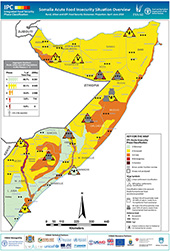
- Somalia continues to face a volatile and complex food and nutrition crisis, with the risk of Famine (RoF) identified for the second consecutive IPC analysis. Acute food insecurity remains high due to a combination of factors, including the lingering effects of previous droughts, erratic rainfall in the 2026 April-to-June Gu season, conflict and insecurity, and above-average food prices, and El Niño related flooding during the forthcoming 2026 October-to-December Deyr season. Between July and September 2026, nearly 5.1 million people (26 percent of the analysed population) are facing high levels of acute food insecurity—IPC Acute Food Insecurity (AFI) Phase 3 or above (Crisis or worse). This includes close to 1.4 million people (7 percent of the analysed population) in IPC AFI Phase 4 (Emergency), which is characterised by large food gaps and high levels of acute malnutrition. While this reflects better-than expected seasonal improvement compared to the last analysis in April 2026, it represents a 50 percent year-on-year increase since July–September 2025 and the second highest number of people in IPC AFI Phase 3 or above since 2017. This steep deterioration from last year comes amid a sharp decline in humanitarian funding and response capacity, with humanitarian food security assistance (HFSA) expected to decline further in the coming months.
- The key drivers of acute food insecurity are: Poor rainfall, flooding, conflict and insecurity, and persistent high food prices. Contributing factors for acute malnutrition are: Large food consumption gaps, high disease burden, extremely poor child feeding and childcare practices, poor access to health and nutrition services, and limited access to sufficient, clean water and sanitation facilities.
- Gu season rainfall performance, although below average, contributed to the seasonal improvement in food security in pastoral, agropastoral and riverine areas in the current period. However, well below-average October–December 2025 Deyr harvests for key staples has kept food prices high in many parts of the country. Flooding, drought and conflict in central, southern, and some parts of northern Somalia have displaced populations and disrupted livelihood activities and market access.
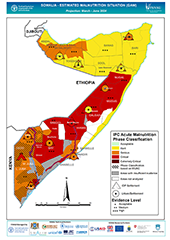
- Acute malnutrition remains of high concern in Somalia, with an estimated 1.92 million children aged 6–59 months suffering or expected to suffer from acute malnutrition and in need of treatment between July 2026 and June 2027, including 433,000 cases of severe acute malnutrition (SAM). Nearly 62 percent of estimated cases are concentrated in the southern part of the country due to reduced access to health and nutrition services, disease outbreaks, acute food insecurity, and poor access to water and sanitation. Compared to the 2025 Gu season, the current global acute malnutrition (GAM) burden has increased by 4 percent, while SAM has increased by 3 percent. In this post-Gu analysis, 19 population groups have been classified as IPC Acute Malnutrition (AMN) Phase 4 (Critical), reflecting a significant deterioration compared to historical trends and worse than 2022.
- The upcoming 2026 Deyr season rains, coinciding with the October–December 2026 projection period, are expected to be average to above-average in most of Somalia, largely due to the El Niño phenomenon. During this time, there is a 75 percent chance of an historic event that would exceed the strength of previous El Niño events dating back to 1950. Food insecurity impacts are expected to be mixed with improved conditions in most pastoral and agropastoral areas, and severe deterioration in riverine livelihoods, low-lying internally displaced person (IDP) settlements, agropastoral livelihoods, and urban areas. In areas not affected by flooding, seasonal improvements are expected due to increased agricultural activities and labour opportunities, as well as improved livestock health and milk production due to increased pasture and water availability. Conversely, El Niño-induced heavy rains and severe flooding are expected to trigger displacement, disrupt markets and livelihoods, and damage crops, livestock, and productive assets. Similar to 2023, floods may delay Deyr cultivation beyond the optimal planting window, reducing agricultural production and household food access.
- During the projection period, food insecurity is expected to worsen, with an estimated 5.4 million people (28 percent of the population analysed) likely facing IPC AFI Phase 3 or above conditions, largely driven by increased displacement due to flooding, drought, and conflict. Alarmingly, this includes 1.5 million people in IPC AFI Phase 4 (Emergency) and close to 26,000 people among Baidoa IDPs in Bay Region expected to be in Catastrophe (IPC AFI Phase 5), which is characterised by starvation and the collapse of livelihoods. In a plausible worst-case scenario in which El Niño leads to more severe flooding and displacement than currently expected, Baidoa IDPs face a risk of Famine between October to December 2026, especially if humanitarian assistance remains insufficient to cover food consumption gaps.
- Acute malnutrition is expected to deteriorate significantly in the projection period. El Niño rains will likely heighten disease burden and outbreaks in IDP settlements, compromise access to safe water and hygiene practices, and severely limit access to health and nutrition services. Beletweyne IDPs are expected to deteriorate from IPC AMN Phase 4 (Critical) to Phase 5 (Extremely Critical) while substantive deterioration towards the upper limit of IPC AMN Phase 4 is expected in seven areas: Bari Urban IDPs (Bossaso), Bay Urban IDPs (Baidoa), Nugaal Urban IDPs (Garoowe), Beletweyne District, North Gedo Riverine, Bay Agropastoral and Shabelle Riverine livelihoods. The expected impact of El Niño rains will drive this deterioration, with flooding, reduced access to safe water and sanitation facilities, increased child illnesses, a higher risk of disease outbreaks, and limited access to health and nutrition interventions. Increased population displacement will aggravate these conditions, leading to overcrowding and limited resources at IDP settlements.
- While conditions remain severe, the acute malnutrition situation among agropastoral populations in Burhakaba district has shown a significant improvement since the April 2026 analysis, which identified the area as at risk of Famine through June 2026. GAM was at 22.6 percent in August 2026, indicative of IPC AMN Phase 4 (Critical), compared to 37.1 percent in April 2026, indicative of IPC AMN Phase 5 (Extremely Critical). This is largely attributed to the scale-up of targeted humanitarian response in health and nutrition, and improving food security.
- Severe humanitarian funding constraints are limiting the coverage of lifesaving food, nutrition and health assistance. Planned HFSA from July to September 2026 will reach only 411,500 people (2 percent of the total population), while 5.1 million people (26 percent of the total population) are in need of urgent action. Assistance will decline further from October to December 2026 despite increasing needs, reaching less than 0.5 percent of the total population. Funding reductions have also led to the closure of 233 nutrition sites and 380 health facilities, reducing households’ capacity to prevent and treat acute malnutrition.
- Urgent action is critical to save lives and mitigate the high levels of need forecasted for October to December. This includes an immediate and targeted scale up of humanitarian food security assistance as part of an integrated humanitarian response and alongside anticipatory action.
Click this link to download full report in pdf format.

 Send by email